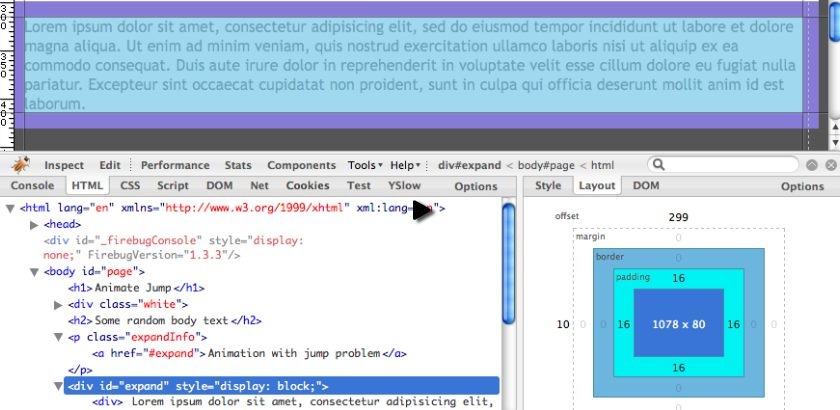
jQuery has got good base level support for effects out of the box. Setting them up and using them to reveal and hide elements is exceptionally easy.
However, on more than one occasion I've found that after creating a sliding effect, the animation jumps on completion.
Having found the cause, I thought it only fair to share and explain why it's happening and how to avoid it.
Watch the animation jump fix screencast (alternative flash version)
QuickTime version is approximately 7Mb, flash version is streaming.
View the demo and source code used in the screencast
Understanding the Problem
The way the slide animation works is it animates the height CSS property of the element. The problem occurs if the element being animated has a margin or padding.
This is because when the element shifts from display: none to a tiny height (or width) and visa versa, the padding (or margin) jumps in to view, causing the real height to be height + padding + margin.
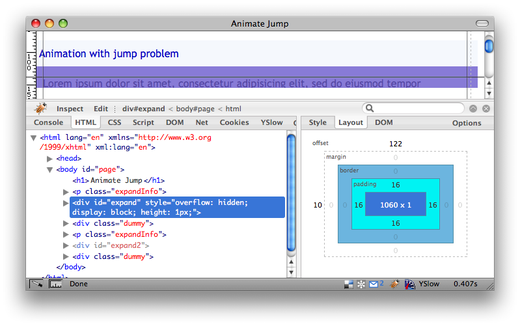
If you look at the screenshot below, you can see the padding is still visible but the height of the element is 1px, the next step is the to display: none, which in this case, the blocks below will jump up 32px (padding-top + padding-bottom).
Fixing the Problem
The solution is very simple to fix once you've understood the problem.
The problematic code would have the following style:
#expand {
padding: 16px;
display: none;
}
The code required to create the smooth animation is:
#expand {
display: none;
}
#expand div {
padding: 16px;
}
We've moved the padding away from the animating element and so only the height affects the height of the sliding block.
August 19, 2008 at 14:11
I think this is a fantastic little tutorial.
I wonder if you have ever thought about publishing some VERY basic tutorials for jQuery? I would love to get started with it (as I always learn fast once I have the basics) but haven't found any beginner tutorials that are as well illustrated and thought out as your more advanced tutorials here.
Again, great job.
August 19, 2008 at 14:19
That makes so much sense! Thank you. I've been annoyed by this problem but never bothered trying to bugfix it. And to think that IE6 don't have the jumpy problem (sometimes) oughta ring some bells early on.
August 19, 2008 at 14:33
Simple as that. This has bothered me before, thanks for a nice and simple solution.
August 19, 2008 at 15:22
@Rusti - I've been giving some thought to doing screencast introductions to the jQuery API focusing on particular functions like show/hide, selectors, ajax, etc.
August 19, 2008 at 17:09
This is great! I have been wondering where that issue was coming from.
Thanks!
August 19, 2008 at 17:59
This solution is really neat, thanks!
August 19, 2008 at 18:18
Awesome. This has been such a pain for me with a number of projects. Thanks!
August 19, 2008 at 18:36
haha nice! i just noticed this issue last week on one of my projects and now you found the cause and solution :)
August 19, 2008 at 21:16
wow, and i always wondered why it jumps! helped me a lot!
August 19, 2008 at 21:58
Thanks so much for taking the time to write this up.
August 20, 2008 at 07:54
wow information provided through is post I Really liked it.Thanks for sharing.
August 21, 2008 at 07:27
Another good tutorial. Greetings from Italy
August 21, 2008 at 21:31
Great little tip. Had this issue pop it's ugly little head today and remembered seeing something in my rss reader on how to fix it. Great content on this site... keep it up.
August 22, 2008 at 17:49
The solution is very similar to one of the methods to use to adjust the box model in IE 6. Instead of creating additional styles for IE 6, just put your width and height on a wrapper div, then put the padding you want on an inner div. It requires an extra tag, but it has additional benefits (in addition to adjusting for the box model) such as being able to apply a 2nd background to a region. I use this method frequently, but didn't know why my animations jumped until now. Thanks for the insight.
August 25, 2008 at 01:18
This is great...I've been searching a solution for 2 days. Thanks
August 26, 2008 at 15:00
Generally you don't want to apply margin/padding to containers anyway, especially when you set a width.
August 28, 2008 at 21:57
For Safari there is still a pixel height jump with autoHeight enabled. This is without any border,margin and padding on the animated element. Are there any work around for this issue?
You can see this behavior in the Jquery demo page with Safari 3.1.2 : http://dev.jquery.com/view/trunk/plugins/accordion/demo/
September 4, 2008 at 18:31
Thanks! That's an excellent tip. Shame about the unnecessary nested element to handle margin/padding, but that's a CSS (not jQuery) issue... Ditto Paul Gendek's post.
September 11, 2008 at 10:51
I'm having this problem because my
has padding on it and I can't find a workaround - how can I retain the relevant padding on my p element, yet lose the jump?
September 11, 2008 at 10:52
the missing text above should say p element
September 11, 2008 at 12:03
This doesn't seem to work for me when my hidden div has 2 paragraphs of text inside it that are padded with the p tag. I can't seem to find a workaround, other than setting the padding on the p tag to 0, but then that doesn't format my text the way I would like it - can anyone help??
September 11, 2008 at 12:13
@Dave - if you post up a working URL to the problem you're working on, someone, or I, might be able to take a look and propose a fix. Cheers.
September 11, 2008 at 21:52
Hi Remy, thanks for the response - the working URL is the link from my name - yep, I'm editing live!
September 11, 2008 at 22:46
Oh - and I should say, it's the More... link under the intro para
September 15, 2008 at 06:56
Thanks! That's an accomplished tip. Shame about the accidental nested aspect to handle margin/padding, but that's a CSS (not jQuery) issue... Ditto Paul Gendek's post.
September 15, 2008 at 16:14
Thanks, I've been wondering about that!
September 19, 2008 at 02:10
You know this tutorial for animation can also help newbies....Its quite clear from where i look at it.... :)
September 19, 2008 at 20:04
I'm encountering the same bug Dave Ellis is seeing, which I think is caused by margin collapsing on the paragraph tags. I removed the top margin from my <p>'s and the jump virtually disappeared. I say virtually because I still get a little shimmy (yes, I said shimmy) on the bottom of the animating div.
September 25, 2008 at 18:02
fantastic. your screen casts are perfectly executed and very helpful!
September 30, 2008 at 20:12
Man, that always bugged me! Thanks for sharing that. Totally makes sense now.
October 3, 2008 at 18:32
Love it! Thank You.
October 9, 2008 at 04:46
i'm having a similar problem with animate function - however its do do with animating the height and width of a relatively positioned image. The image jumps to a spot and then jumps back. its animated with: - any ideas? $("img").filter(".button").hover(function() { $(this).animate({height:"69px",width:"70px"},time); }, function() { $(this).animate({height:"60px",width:"60px"}, time); });
October 18, 2008 at 00:46
I was having this problem, and annoyingly, this solution wouldn't work for me. After a bit of debugging I found out that the negative margin and width of a parent element was causing the issue; unfortunately the design depended on these values.
My solution was to find the height of the element being animated before hiding, and then apply the height value before animating it:
var $elementHeight = $("#element").height(); $("#element").hide(); $("a").click(function() { $("#element").css({height: $elementHeight}); $("#element").slideToggle(800); return false; });Hope this saves someone else an hour or two :)
October 18, 2008 at 16:03
I also had an animation jump problem, but that was because the animated div content had EM sizes in it. To fix it, I had to change it to px or %. Maybe this can help somebody.
November 6, 2008 at 11:16
Thanks! That's an able tip. Shame about the adventitious nested aspect to handle margin/padding, but that's a CSS (not jQuery) issue... Ditto Paul Gendek's post.
November 11, 2008 at 10:49
Thanks so much, I've always hated this problem.
I wonder how mootools manages to avoid this problem.. perhaps it automatically detects margins and padding and also animates them to zero.. That could be a more semantic solution.
Otherwise, a great tip, and thanks a million!
November 27, 2008 at 17:24
Thanks for this. Although I do have a slightly weird problem in IE6, where instead of starting collapsed and expanding, the div starts out expanded and collapses. Any ideas what could be causing this?
December 2, 2008 at 21:37
This is very helpful - I never understood this problem until now.
I found a situation where the problem will occur despite the fix. In the demo code, use Firebug to explicitly set the width of the body to anything, like 1000px.
The only solution I've found is to also set the width of whatever you're sliding.
December 18, 2008 at 15:38
I'm trying to get to grips with CSS, JavaScript etc but its slow going. I experiment by copying scrip and then fiddling about with it and eventually understand some of it. I was trying to do this with the animation-jump script but cannot get it to work. I have an html file an exact copy of the working demo and the jquery-1.2.6.min.js file both in the root folder but not a twitch when clicking on the link. I'm obviously missing something fundamental and would a welcoem a clue to a solution.
December 19, 2008 at 17:40
@Fen: Thanks!
I too still had the jump with the fix, but your solution to remember the height and set it before sliding out, worked for me.
December 29, 2008 at 14:40
I always wondered why that happened, I thought it was just buggy javascript code... : )
brent @ mimoYmima.com
January 1, 2009 at 12:51
This is very helpful - I never understood this problem until now.